Built for AI pipelines • RAG-ready • Headless automation

Turn documents into AI-ready knowledge — and AI output into production-grade deliverables.

   Antenna House tools are designed for automation: clean HTML for RAG, Sanitize your inputs into PDF, consistent publishing for compliance, and scalable conversions for pipelines. Command-line interfaces remove GUI friction and reduce failure points for AI.    AI can generate documents, but not always production-ready ones. Antenna House is the layer that organizations adopt when AI output needs to become reliable, compliant, and professionally publishable.  

Command Line tools for AI workflows 


Why Antenna House wins in AI workflows

AI agents can orchestrate reliable pipelines when actions are explicit, repeatable, and observable. GUI-based editing introduces extra interpretation steps and unnecessary failure points.

Fewer failure points
Skip “view → interpret → click” loops. Use deterministic commands in pipelines.
Designed for automation
Options files, logs, exit codes, and reproducible conversions make AI integration easier.
Scale with confidence
Headless processing fits containers and microservices—ideal for high-volume workloads.
 
AI integration outcomes
 
 
Convert legacy Word content into a knowledge base format AI systems can retrieve.
 
Publish AI results into branded PDFs with consistent styles and tagging.
 
Run scalable conversions in automated environments without GUI dependencies.
Who this is for
AI & automation teams • Document management vendors • Public sector workflows • Publishers • Integrators • Anyone building RAG pipelines on legacy Office content

Antenna House and AI workflow


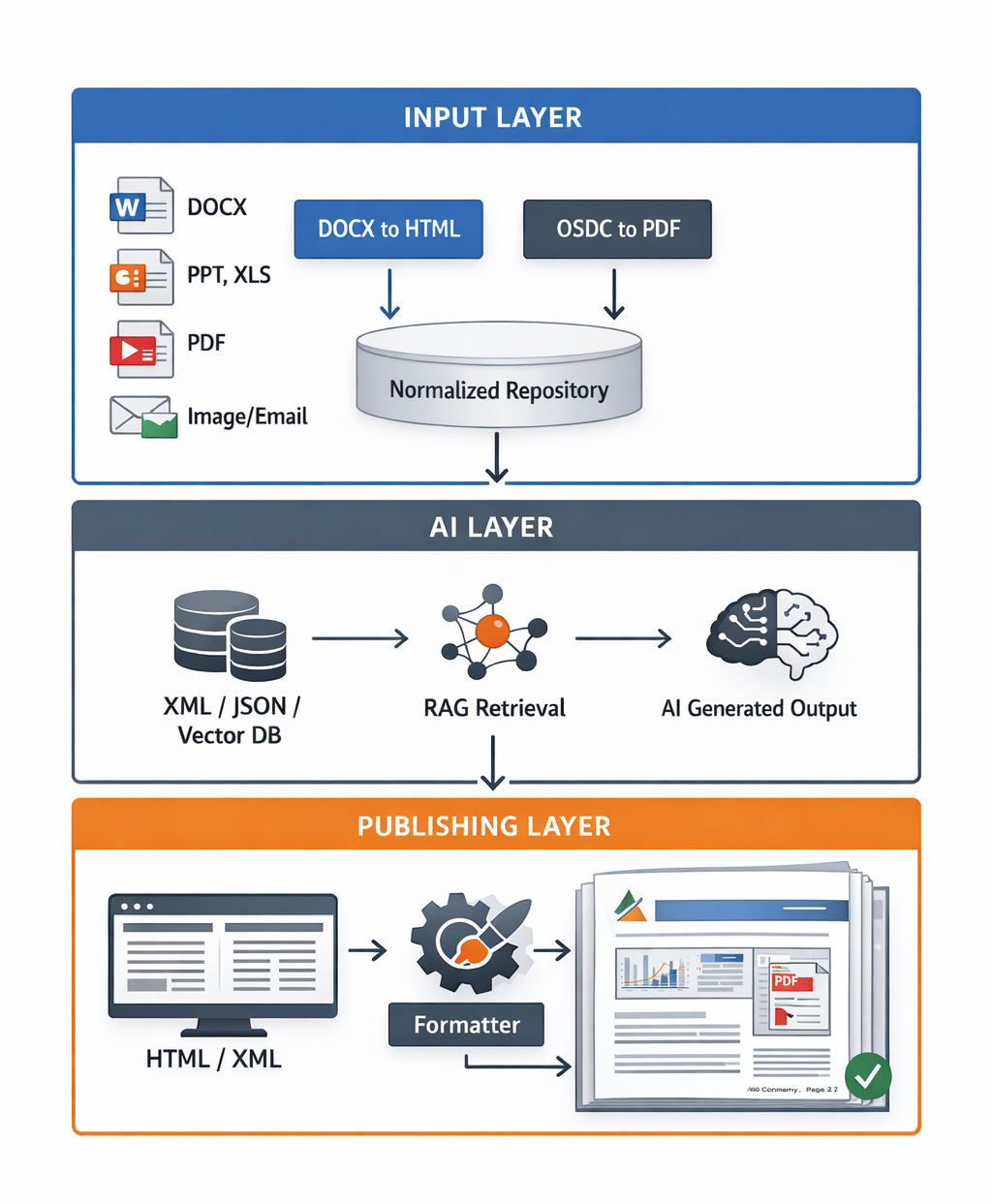
Workflow Outline Antenna House and AI

1. Input Normalization & RAG Readiness

Organizations receive documents in many formats: DOCX, Excel, PowerPoint, PDFs, images, and email attachments.

Using DOCX to HTML and OSDC, these files are immediately converted into structured HTML or standardized, secure PDFs.

2. AI & Knowledge Layer

Once normalized, documents can be indexed and stored as XML, JSON, or within vector databases for retrieval-augmented generation (RAG).

 Because the input has been normalized and structured, AI operates on consistent, reliable data — improving accuracy and reducing formatting errors. 

3. Deterministic Publishing

AI-generated HTML or XML content is passed to Antenna House Formatter for final production.

 External PDFs can also be merged or embedded into branded output documents, allowing complete control over final deliverables. 


ChatGPT Image Feb 24, 2026, 02_17_43 PM

Why Antenna House?


Automation-first architecture: command line + options files + predictable output 
  • Designed for automation from the ground up.
  • Repeatable jobs, predictable results, less manual effort.
  • Integrates cleanly into scripted and AI-driven workflows.
  • Consistent output at scale for production document pipelines.
Publishing-grade engine: not “AI output”, but layout rules, templates, and repeatability 
  • From generated content to governed output.
  • Production-ready publishing, not just AI-generated pages.
  • Consistent layout, repeatable structure, professional results.
  • Transforms “almost right” AI output into finished documents.
Runs where you need it: on-prem, private cloud, containers
  • Deploy with flexibility, without compromising control.
  • Runs in the environments enterprise customers already trust.
  • Supports secure, private, and containerized deployments.
  • Built to fit real-world infrastructure requirements.